Wednesday, 26 August 2026

Why landlords are pushing rents higher — and why that can backfire at refinance

If you have been following lettings news, you could be forgiven for thinking landlords are simply taking advantage of tighter supply to push asking rents higher. But for investors, the more interesting question is whether this is a durable pricing shift or a defensive move that could create vacancy, affordability and refinance risk.

Property Industry Eye reported that some Chestertons landlords are lifting asking rents after the ban on encouraging bidding wars, with the logic being straightforward: pitch slightly above target and let tenants negotiate down. The same report said lower supply and stronger demand are still supporting the market, while another Property Industry Eye piece noted that in London the gap between advertised and achieved rents widened in July. Rightmove’s rental tracker also showed asking rents rising 2.9% year-on-year in the second quarter of 2026, the strongest annual growth in two years.
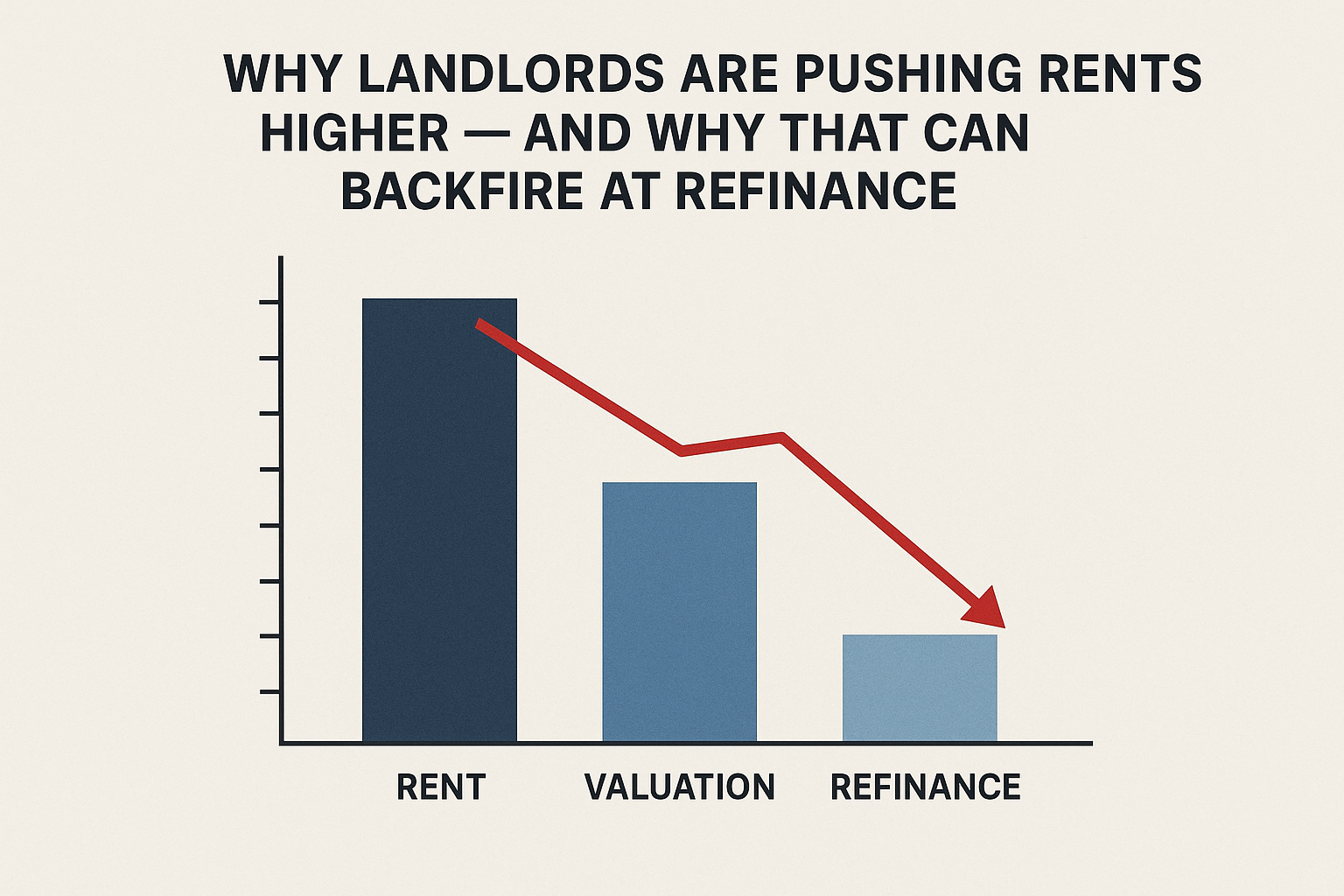
Why landlords are pushing rents higher — and why that can backfire at refinance

The real risk is friction pricing

That sounds positive on the surface, but it can turn into what you might call friction pricing: more listings look strong on paper than they are in reality. Once asking rents are built with “room to negotiate” baked in, the gap between headline and achieved rent can widen quietly. That is where voids creep in, lets slow down and net yield starts to soften even though the gross figure looks healthy.

For landlords, this is not just a marketing issue. A property that sits empty for an extra couple of weeks can wipe out much of the benefit of chasing a higher headline rent. For investors refinancing, it matters even more. Lenders and valuers are interested in the rent the asset can actually sustain, not the rent that sounded ambitious on the day the listing went live.

That is why optimistic pricing can become self-defeating. If the market starts to treat asking rent as a negotiation anchor rather than a realistic target, the number on the advert becomes less useful as a basis for underwriting.

Regulation is changing behaviour as well as rules

The broader backdrop is the Renters’ Rights Act. GOV.UK says Phase 1 of the reforms began on 1 May 2026, with further changes due from late 2026. The Act removes section 21, strengthens tenant protection and changes how rent increases and possession risk work.

That matters because landlord behaviour often shifts before the data does. Some owners respond to uncertainty by trying to lock in higher entry rents. Others decide the regulatory burden is too much and sell. Both reactions can be true at the same time. For investors, the key point is not whether rents are simply rising. It is whether the rise reflects genuine tenant demand and supply pressure, or whether it is a defensive move that tenants can only absorb for so long.

Affordability still sets the ceiling. Mortgage costs, household budgets and employment confidence all affect what tenants can pay. The Bank of England’s July 2026 Monetary Policy Report said Bank Rate remained at 3.75% at the 29 July 2026 meeting, but borrowing costs can still feel tighter than the headline rate suggests once lender pricing and swap movements are taken into account.

What this means for valuation and refinance

This is where the story becomes commercial rather than just editorial. If a local market is showing higher asking rents but slower enquiries, a valuer may not fully credit the uplift you are hoping for in a refinance model. The result can be a weaker income profile than the one built into your spreadsheet.

That can affect more than one part of the deal. Lower achievable rent can reduce debt service headroom, limit borrowing capacity and leave more equity trapped in the asset than planned. In other words, a rent number that looks impressive in a brochure may not translate into refinance strength if the achievable rent is softer.

The same logic applies to small developments, conversions and mixed-use schemes. If the exit depends on investment demand, your numbers need to survive a market where landlords are pricing ambitiously but tenants are still price-sensitive. The safest assumption is usually not the highest asking rent. It is the rent that can be achieved consistently after voids, turnover, incentives and compliance costs.

The investor takeaway

The best response is not to chase the highest number on the letting board. It is to underwrite on achieved rent, stress-test for a longer letting period and ask whether the asset still works if the market becomes less forgiving.

That does not mean rents cannot rise. It means the most resilient properties are the ones that can still let quickly at a sensible figure, with enough margin for finance costs, management and an eventual exit. If the market is becoming more selective, well-presented stock with realistic pricing may outperform over time. If your deal only works on optimistic rent assumptions, the new regime is more likely to expose that weakness than hide it.

For landlords and investors, the key question is no longer, “How high can I push the rent?” It is, “What rent will still look credible to a tenant, a valuer and a lender three months from now?” That is a much better test of whether the income is real.


Friday, 14 August 2026

Why UK homebuying reform matters to investors, landlords and refinancing deals

There is a tendency in property to treat homebuying reform as a consumer story and move on. That is a mistake. If you buy, refurbish, develop, let or refinance property, the way transactions are packaged and completed has a direct effect on cash flow, valuation risk, exit timing and the credibility of your finance plan.

The Government’s home buying and selling reform roadmap is aimed at making transactions faster, cheaper and less likely to fall apart. The wider reform material says the current process takes an average of 120 days and around one in three transactions fails, which is exactly the sort of friction that can distort a deal model when you are relying on a sale or refinance to clear debt and release equity. The national picture still masks regional differences, but the direction of travel matters.

Why UK homebuying reform matters to investors, landlords and refinancing deals

That matters because time is not just an inconvenience in property. Time is interest, voids, insurance, council tax, contractor drag, sales risk and lender pressure. A process that becomes more structured could help disciplined operators. But it will also expose weak preparation faster.

UK residential homes with survey paperwork and keys, representing homebuying reform and transaction risk

What has changed

In June 2026, the Government published its home buying and selling reform roadmap. It points to a future where buyers receive more upfront information, digital property packs become more important, and the overall transaction process is streamlined. The stated aim is to deliver a system that works better for households, the market and the wider economy by the end of this Parliament.

The roadmap includes measures around upfront property information, professionalising agents, digital property logbooks and packs, binding conditional contracts and better material information in listings. In plain English, that means more of the important facts should be available earlier, rather than surfacing late in the process when deals are already fragile.

At the same time, the wider market is still operating under tighter money and uneven sentiment. Bank Rate was held at 3.75% at the July 2026 Monetary Policy Committee meeting, so borrowing costs remain a live issue for owners and investors alike.

The immediate impact on deal economics

If you are buying, the biggest benefit is certainty. If fewer deals collapse, you waste less time and money on aborted legals, survey fees and rearranged finance. If you are selling, better information upfront may reduce renegotiation risk later in the process. If you are refinancing, a cleaner exit route makes the lender more comfortable with the repayment plan.

But there is another side to it. More information earlier in the process means weaker deals are easier to spot. That is good news if your file is clean. It is bad news if you have been relying on vague listings, optimistic assumptions or delayed disclosure to get a transaction across the line.

For developers, the issue is especially important. A delayed sale at the end of a project can turn a decent margin into a thin one very quickly. If the market becomes more transparent, valuers and buyers may also become more demanding about evidence. That affects gross development value assumptions, end-sale timing and the contingency budget you should carry. It may also be relevant to bridging finance exit windows, where a delay can push costs up faster than the numbers in the original appraisal suggest.

For landlords, the practical impact is more subtle but still important. If you plan to sell a tenanted asset or recycle capital out of a mature holding, the ease of getting through the sales process matters. Anything that reduces fall-through risk improves your ability to time exits and manage refinancing decisions more confidently.

There is also a refinance angle that is easy to miss. More upfront information can strengthen the case for a clean refinance later, but it can also mean lenders expect a better paper trail at the start. In other words, the same reform that supports a smoother exit may also raise the standard of evidence you need when the deal is being assessed in the first place.

The upside is better execution

There is a commercial advantage in being better prepared than the competition. If the market moves towards fuller upfront packs and earlier disclosure, the people who already work that way will benefit first. Their deals are less likely to stall, and their exit assumptions will be more credible when judged by a buyer, lender or valuer.

That is particularly relevant where you are buying from motivated sellers. A seller who wants certainty may prefer the buyer who can show the cleanest process, the strongest funding position and the least chance of last-minute renegotiation. In a tighter market, operational discipline can matter as much as headline price.

It may also create a modest advantage for portfolio holders and developers who are ready to sell into a more efficient market. If transaction friction falls, capital can move faster. That is useful if you want to de-risk a project, return money to investors or prepare for the next acquisition.

The risk is assuming reform fixes a weak deal

Do not confuse a better process with a better valuation. A quicker sale system does not make a bad price good, and it does not rescue a project with weak comparables. The same applies to finance. A lender still wants to know what the asset is worth, what the exit is, how long the exit might take and what happens if it takes longer than planned.

The most common mistake in deal thinking is treating a hoped-for smoother market as if it were guaranteed. It is not. The roadmap is a policy direction, not an instant change in transaction behaviour. Even where the reforms are implemented, local conditions will still matter far more than the national narrative.

So if you are underwriting a purchase or refinance now, the right question is not whether reform sounds helpful. The right question is whether your numbers still work if the buyer, lender or valuer asks for better evidence and takes a more cautious view on timing.

What a cautious investor would check now

Start with the exit. If your plan depends on a sale, ask how long the transaction could realistically take if the buyer is slower than expected or the chain becomes more complicated. Then test the deal against a longer hold period and a higher cost of carry.

Next, look at your information pack. Would a buyer or lender be comfortable with the paper trail you can produce today? That includes title, tenure, planning history, works information, compliance evidence, tenancy detail if relevant, and anything else that will support the valuation story rather than undermine it.

Then stress the refinance. If the deal only works at the best possible valuation and the fastest possible completion, it is fragile. If it still works with a modest haircut to value and a delay to completion, it is far more robust.

Finally, think about how this changes your negotiation. If buyers are going to expect more information earlier, then missing documents, unclear leasehold costs or messy property history become more expensive. That can weaken your price if you are selling, but it can also create an opportunity if you are buying and are willing to do the work properly.

The commercial takeaway

Homebuying reform is worth watching not because it is fashionable, but because it affects how property money moves. Faster, more transparent transactions could reduce friction for well-prepared investors and punish sloppy ones. That has real consequences for purchase strategy, funding confidence, valuation evidence and exit planning.

If you are serious about protecting margin, treat this as a reminder to improve the quality of your own process now. In a market where the paperwork may matter more, the cleanest deal file is often the strongest asset you have.

Sources

Tuesday, 4 August 2026

Why EPC C is now a finance issue, not just a compliance issue

For many UK landlords and property investors, EPC ratings used to sit in the background. Useful to know, but not urgent. That has changed. Energy performance is now a finance issue, a valuation issue and, in some cases, an exit issue.

If you are buying, holding, refinancing or planning to sell a rented property, the question is no longer simply whether the building can be let today. It is whether the asset will still be financeable, lettable and saleable once the market, regulation and lender appetite move on again.

Why EPC C is now a finance issue, not just a compliance issue

The current rules still say domestic private rented properties in England and Wales must meet at least EPC band E unless a valid exemption applies. Government has also said it is exploring longer-term standards, with the ambition of as many rented homes as possible reaching EPC band C or equivalent by 2030. GOV.UK guidance

That may sound like a compliance discussion. In practice, it goes much further than that.

The property you can let today may still be the property you struggle to finance tomorrow

The obvious risk is the direct cost of upgrading. The less obvious risk is that a poor EPC weakens your negotiating position with lenders, purchasers and valuers. A tired house with a low EPC can still have rental demand, but the pool of lenders and buyers willing to back it on sensible terms can narrow quickly if more capital spending is needed before it becomes acceptable stock.

That matters most when your deal depends on leverage. If you are using bridging, development finance or a short refinance window, the exit needs to be credible. A property that needs works to improve thermal performance is not automatically a bad deal, but it is a deal with more moving parts. More moving parts means more risk of delay, more cash tied up and more chance that the refinance assumption becomes optimistic.

For landlords, the commercial point is simple: EPC spend is no longer just maintenance. It is part of your capital planning. If you leave it too late, you may end up doing rushed works under pressure, at the same time as you are dealing with voids, tenant turnover or a refinancing deadline. That is the expensive way to do it.

What the current rules are really telling the market

Government guidance still sets the legal floor at EPC band E for most privately rented homes in England and Wales, but the market is already pricing in the next step. That means lenders, buyers and valuers are looking beyond today’s minimum standard and asking what the asset will cost to keep financeable.

In practice, that can affect product choice, credit appetite and valuation commentary. Some lenders are also increasingly marketing greener lending options, which can give better-positioned assets a wider financing conversation than weaker stock.

That matters because finance does not wait for a rule to become fully binding before reacting to it. Buyers do not wait for the final commencement date before starting to discount risky stock. And valuers are already aware that poorly performing assets may need more explanation, more evidence and, in some cases, a more cautious approach to value.

There is also a practical refinancing angle. When you refinance a property, the lender is not only looking at the current rent. It is also looking at the durability of that income. If a unit has EPC weaknesses that could require material capex soon, that can affect perceived sustainability of cash flow, especially where the net yield is already thin.

Where the opportunity sits for active investors

This is not just a warning. It can also be an opportunity if you buy with your eyes open.

Properties with low EPC ratings are not automatically poor purchases. Sometimes they are exactly where the better buying opportunities appear, because the previous owner has not done the work, does not want to do the work, or has not understood how the market now views the asset. That can create room on price, especially if the buyer can fund improvements sensibly and hold through the works without straining cash flow.

For landlords who are prepared, this can become a portfolio tidy-up exercise rather than a fire drill. You identify the worst stock first, cost the improvements properly, and decide whether to keep, refinance or sell. The key is to treat the exercise commercially, not emotionally. A property that is cheap to buy but expensive to fix may still work. A property that is cheap to buy but weak on exit and awkward to finance may not.

Developers should be thinking about the same issue in a different way. If you are converting or refurbishing for resale, an EPC weak finish can reduce buyer confidence even where the cosmetic presentation is strong. If you are converting to hold, the rating can affect the lending conversation later. Either way, energy performance should be part of the appraisal from the start, not an afterthought once the build is complete.

The due diligence checklist before you rely on the asset

Before you commit to a purchase or refinance, it is worth understanding the EPC position properly, not just glancing at the headline rating in a listing.

  • Check the actual EPC report, not only the headline rating.
  • Identify the measures that would move the property to the next band and estimate the real cost, not the optimistic one.
  • Ask whether the works are best done before purchase, during refurbishment or before refinance.
  • Test the effect on monthly cash flow if the works take longer than planned.
  • Consider whether the property will still appeal to the likely buyer or lender if you decide to exit before upgrading.

The point is not to create bureaucracy. The point is to avoid pretending that a weak EPC is a minor detail when it could affect the whole return profile.

The investor’s bottom line

Property investors often think in separate boxes: purchase price, rent, finance, works, then exit. EPC pressure blurs those boxes. It can affect all of them.

A property that needs upgrading may support a lower entry price. That is the opportunity. But the same weakness may reduce valuation confidence, increase holding cost and complicate exit if the buyer pool is thin. If you are financing the deal, the lender may be more interested in the route to compliance than the current asking price. If you are selling, the buyer may ask what the EPC means for future spend, not just for today’s rent.

That is why the strongest investors will not ask, “Can I let this now?” They will ask, “What does this property look like after the next round of lending, compliance and buyer scrutiny?”

If the answer is that the asset still works after sensible upgrades, the deal may be worth doing. If the answer is that the investment only works while you ignore the EPC issue, then it is probably a fragile deal.

The headline lesson is straightforward: EPC C is no longer just a sustainability talking point. For landlords, borrowers and developers, it is becoming part of the asset’s financeability and exit story. The earlier you factor that in, the more control you keep over the numbers.

Sources used: